 Add to Chrome
 Add to Firefox
 Add to Edge
NeuroManip: Prosthetic Hand Manipulation System Based on EMG and Eye Tracking Powered by the Neuromorphic Processor AltAi
Jan 25, 2026
This paper presents a novel neuromorphic control architecture for upper-limb prostheses that combines surface electromyography (sEMG) with gaze-guided computer vision. The system uses a spiking neural network deployed on the neuromorphic processor AltAi to classify EMG patterns in real time while an eye-tracking headset and scene camera identify the object within the user's focus. In our prototype, the same EMG recognition model that was originally developed for a conventional GPU is deployed as a spiking network on AltAi, achieving comparable accuracy while operating in a sub-watt power regime, which enables a lightweight, wearable implementation. For six distinct functional gestures recorded from upper-limb amputees, the system achieves robust recognition performance comparable to state-of-the-art myoelectric interfaces. When the vision pipeline restricts the decision space to three context-appropriate gestures for the currently viewed object, recognition accuracy increases to roughly 95% while excluding unsafe, object-inappropriate grasps. These results indicate that the proposed neuromorphic, context-aware controller can provide energy-efficient and reliable prosthesis control and has the potential to improve safety and usability in everyday activities for people with upper-limb amputation.

Glove2UAV: A Wearable IMU-Based Glove for Intuitive Control of UAV
Jan 22, 2026This paper presents Glove2UAV, a wearable IMU-glove interface for intuitive UAV control through hand and finger gestures, augmented with vibrotactile warnings for exceeding predefined speed thresholds. To promote safer and more predictable interaction in dynamic flight, Glove2UAV is designed as a lightweight and easily deployable wearable interface intended for real-time operation. Glove2UAV streams inertial measurements in real time and estimates palm and finger orientations using a compact processing pipeline that combines median-based outlier suppression with Madgwick-based orientation estimation. The resulting motion estimations are mapped to a small set of control primitives for directional flight (forward/backward and lateral motion) and, when supported by the platform, to object-interaction commands. Vibrotactile feedback is triggered when flight speed exceeds predefined threshold values, providing an additional alert channel during operation. We validate real-time feasibility by synchronizing glove signals with UAV telemetry in both simulation and real-world flights. The results show fast gesture-based command execution, stable coupling between gesture dynamics and platform motion, correct operation of the core command set in our trials, and timely delivery of vibratile warning cues.
HumanoidVLM: Vision-Language-Guided Impedance Control for Contact-Rich Humanoid Manipulation
Jan 21, 2026Humanoid robots must adapt their contact behavior to diverse objects and tasks, yet most controllers rely on fixed, hand-tuned impedance gains and gripper settings. This paper introduces HumanoidVLM, a vision-language driven retrieval framework that enables the Unitree G1 humanoid to select task-appropriate Cartesian impedance parameters and gripper configurations directly from an egocentric RGB image. The system couples a vision-language model for semantic task inference with a FAISS-based Retrieval-Augmented Generation (RAG) module that retrieves experimentally validated stiffness-damping pairs and object-specific grasp angles from two custom databases, and executes them through a task-space impedance controller for compliant manipulation. We evaluate HumanoidVLM on 14 visual scenarios and achieve a retrieval accuracy of 93%. Real-world experiments show stable interaction dynamics, with z-axis tracking errors typically within 1-3.5 cm and virtual forces consistent with task-dependent impedance settings. These results demonstrate the feasibility of linking semantic perception with retrieval-based control as an interpretable path toward adaptive humanoid manipulation.
DroneVLA: VLA based Aerial Manipulation
Jan 21, 2026As aerial platforms evolve from passive observers to active manipulators, the challenge shifts toward designing intuitive interfaces that allow non-expert users to command these systems naturally. This work introduces a novel concept of autonomous aerial manipulation system capable of interpreting high-level natural language commands to retrieve objects and deliver them to a human user. The system is intended to integrate a MediaPipe based on Grounding DINO and a Vision-Language-Action (VLA) model with a custom-built drone equipped with a 1-DOF gripper and an Intel RealSense RGB-D camera. VLA performs semantic reasoning to interpret the intent of a user prompt and generates a prioritized task queue for grasping of relevant objects in the scene. Grounding DINO and dynamic A* planning algorithm are used to navigate and safely relocate the object. To ensure safe and natural interaction during the handover phase, the system employs a human-centric controller driven by MediaPipe. This module provides real-time human pose estimation, allowing the drone to employ visual servoing to maintain a stable, distinct position directly in front of the user, facilitating a comfortable handover. We demonstrate the system's efficacy through real-world experiments for localization and navigation, which resulted in a 0.164m, 0.070m, and 0.084m of max, mean euclidean, and root-mean squared errors, respectively, highlighting the feasibility of VLA for aerial manipulation operations.
GuideTouch: An Obstacle Avoidance Device with Tactile Feedback for Visually Impaired
Jan 21, 2026Safe navigation for the visually impaired individuals remains a critical challenge, especially concerning head-level obstacles, which traditional mobility aids often fail to detect. We introduce GuideTouch, a compact, affordable, standalone wearable device designed for autonomous obstacle avoidance. The system integrates two vertically aligned Time-of-Flight (ToF) sensors, enabling three-dimensional environmental perception, and four vibrotactile actuators that provide directional haptic feedback. Proximity and direction information is communicated via an intuitive 4-point vibrotactile feedback system located across the user's shoulders and upper chest. For real-world robustness, the device includes a unique centrifugal self-cleaning optical cover mechanism and a sound alarm system for location if the device is dropped. We evaluated the haptic perception accuracy across 22 participants (17 male and 5 female, aged 21-48, mean 25.7, sd 6.1). Statistical analysis confirmed a significant difference between the perception accuracy of different patterns. The system demonstrated high recognition accuracy, achieving an average of 92.9% for single and double motor (primary directional) patterns. Furthermore, preliminary experiments with 14 visually impaired users validated this interface, showing a recognition accuracy of 93.75% for primary directional cues. The results demonstrate that GuideTouch enables intuitive spatial perception and could significantly improve the safety, confidence, and autonomy of users with visual impairments during independent navigation.
HoverAI: An Embodied Aerial Agent for Natural Human-Drone Interaction
Jan 20, 2026Drones operating in human-occupied spaces suffer from insufficient communication mechanisms that create uncertainty about their intentions. We present HoverAI, an embodied aerial agent that integrates drone mobility, infrastructure-independent visual projection, and real-time conversational AI into a unified platform. Equipped with a MEMS laser projector, onboard semi-rigid screen, and RGB camera, HoverAI perceives users through vision and voice, responding via lip-synced avatars that adapt appearance to user demographics. The system employs a multimodal pipeline combining VAD, ASR (Whisper), LLM-based intent classification, RAG for dialogue, face analysis for personalization, and voice synthesis (XTTS v2). Evaluation demonstrates high accuracy in command recognition (F1: 0.90), demographic estimation (gender F1: 0.89, age MAE: 5.14 years), and speech transcription (WER: 0.181). By uniting aerial robotics with adaptive conversational AI and self-contained visual output, HoverAI introduces a new class of spatially-aware, socially responsive embodied agents for applications in guidance, assistance, and human-centered interaction.
FlightDiffusion: Revolutionising Autonomous Drone Training with Diffusion Models Generating FPV Video
Sep 19, 2025We present FlightDiffusion, a diffusion-model-based framework for training autonomous drones from first-person view (FPV) video. Our model generates realistic video sequences from a single frame, enriched with corresponding action spaces to enable reasoning-driven navigation in dynamic environments. Beyond direct policy learning, FlightDiffusion leverages its generative capabilities to synthesize diverse FPV trajectories and state-action pairs, facilitating the creation of large-scale training datasets without the high cost of real-world data collection. Our evaluation demonstrates that the generated trajectories are physically plausible and executable, with a mean position error of 0.25 m (RMSE 0.28 m) and a mean orientation error of 0.19 rad (RMSE 0.24 rad). This approach enables improved policy learning and dataset scalability, leading to superior performance in downstream navigation tasks. Results in simulated environments highlight enhanced robustness, smoother trajectory planning, and adaptability to unseen conditions. An ANOVA revealed no statistically significant difference between performance in simulation and reality (F(1, 16) = 0.394, p = 0.541), with success rates of M = 0.628 (SD = 0.162) and M = 0.617 (SD = 0.177), respectively, indicating strong sim-to-real transfer. The generated datasets provide a valuable resource for future UAV research. This work introduces diffusion-based reasoning as a promising paradigm for unifying navigation, action generation, and data synthesis in aerial robotics.
PhysicalAgent: Towards General Cognitive Robotics with Foundation World Models
Sep 17, 2025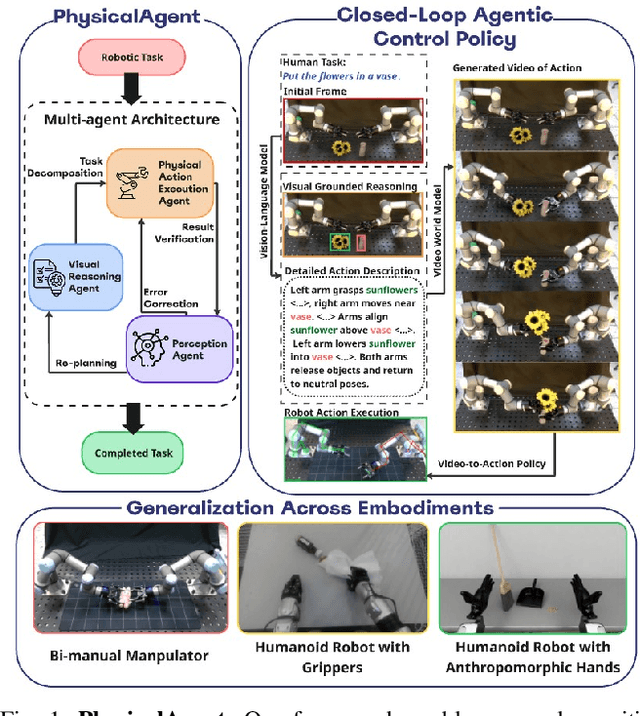
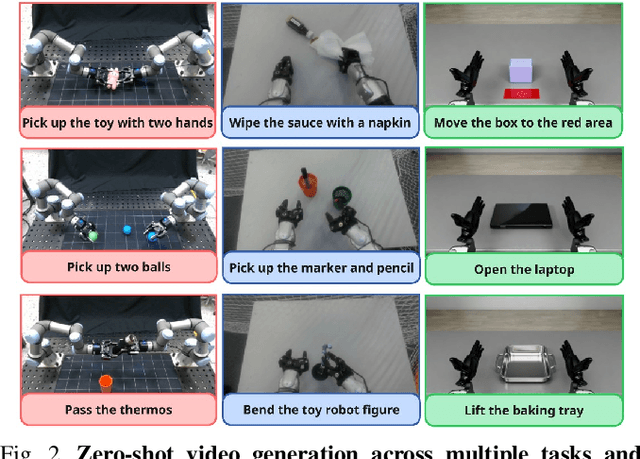
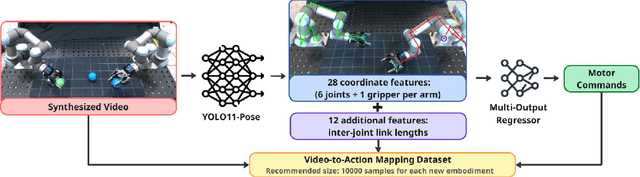
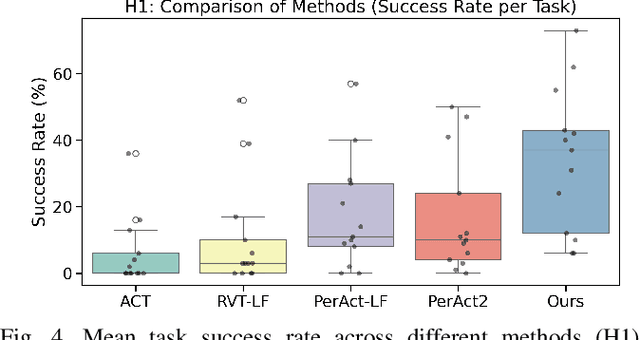
We introduce PhysicalAgent, an agentic framework for robotic manipulation that integrates iterative reasoning, diffusion-based video generation, and closed-loop execution. Given a textual instruction, our method generates short video demonstrations of candidate trajectories, executes them on the robot, and iteratively re-plans in response to failures. This approach enables robust recovery from execution errors. We evaluate PhysicalAgent across multiple perceptual modalities (egocentric, third-person, and simulated) and robotic embodiments (bimanual UR3, Unitree G1 humanoid, simulated GR1), comparing against state-of-the-art task-specific baselines. Experiments demonstrate that our method consistently outperforms prior approaches, achieving up to 83% success on human-familiar tasks. Physical trials reveal that first-attempt success is limited (20-30%), yet iterative correction increases overall success to 80% across platforms. These results highlight the potential of video-based generative reasoning for general-purpose robotic manipulation and underscore the importance of iterative execution for recovering from initial failures. Our framework paves the way for scalable, adaptable, and robust robot control.
HapticVLM: VLM-Driven Texture Recognition Aimed at Intelligent Haptic Interaction
May 05, 2025This paper introduces HapticVLM, a novel multimodal system that integrates vision-language reasoning with deep convolutional networks to enable real-time haptic feedback. HapticVLM leverages a ConvNeXt-based material recognition module to generate robust visual embeddings for accurate identification of object materials, while a state-of-the-art Vision-Language Model (Qwen2-VL-2B-Instruct) infers ambient temperature from environmental cues. The system synthesizes tactile sensations by delivering vibrotactile feedback through speakers and thermal cues via a Peltier module, thereby bridging the gap between visual perception and tactile experience. Experimental evaluations demonstrate an average recognition accuracy of 84.67% across five distinct auditory-tactile patterns and a temperature estimation accuracy of 86.7% based on a tolerance-based evaluation method with an 8{\deg}C margin of error across 15 scenarios. Although promising, the current study is limited by the use of a small set of prominent patterns and a modest participant pool. Future work will focus on expanding the range of tactile patterns and increasing user studies to further refine and validate the system's performance. Overall, HapticVLM presents a significant step toward context-aware, multimodal haptic interaction with potential applications in virtual reality, and assistive technologies.
Evolution 6.0: Evolving Robotic Capabilities Through Generative Design
Feb 25, 2025We propose a new concept, Evolution 6.0, which represents the evolution of robotics driven by Generative AI. When a robot lacks the necessary tools to accomplish a task requested by a human, it autonomously designs the required instruments and learns how to use them to achieve the goal. Evolution 6.0 is an autonomous robotic system powered by Vision-Language Models (VLMs), Vision-Language Action (VLA) models, and Text-to-3D generative models for tool design and task execution. The system comprises two key modules: the Tool Generation Module, which fabricates task-specific tools from visual and textual data, and the Action Generation Module, which converts natural language instructions into robotic actions. It integrates QwenVLM for environmental understanding, OpenVLA for task execution, and Llama-Mesh for 3D tool generation. Evaluation results demonstrate a 90% success rate for tool generation with a 10-second inference time, and action generation achieving 83.5% in physical and visual generalization, 70% in motion generalization, and 37% in semantic generalization. Future improvements will focus on bimanual manipulation, expanded task capabilities, and enhanced environmental interpretation to improve real-world adaptability.